
The Average House Price Number That Is Lying to You (And the One That Is Not)
Here is a question that catches almost everyone out: what does the "average" house price actually tell you? The honest answer is, often, not much.
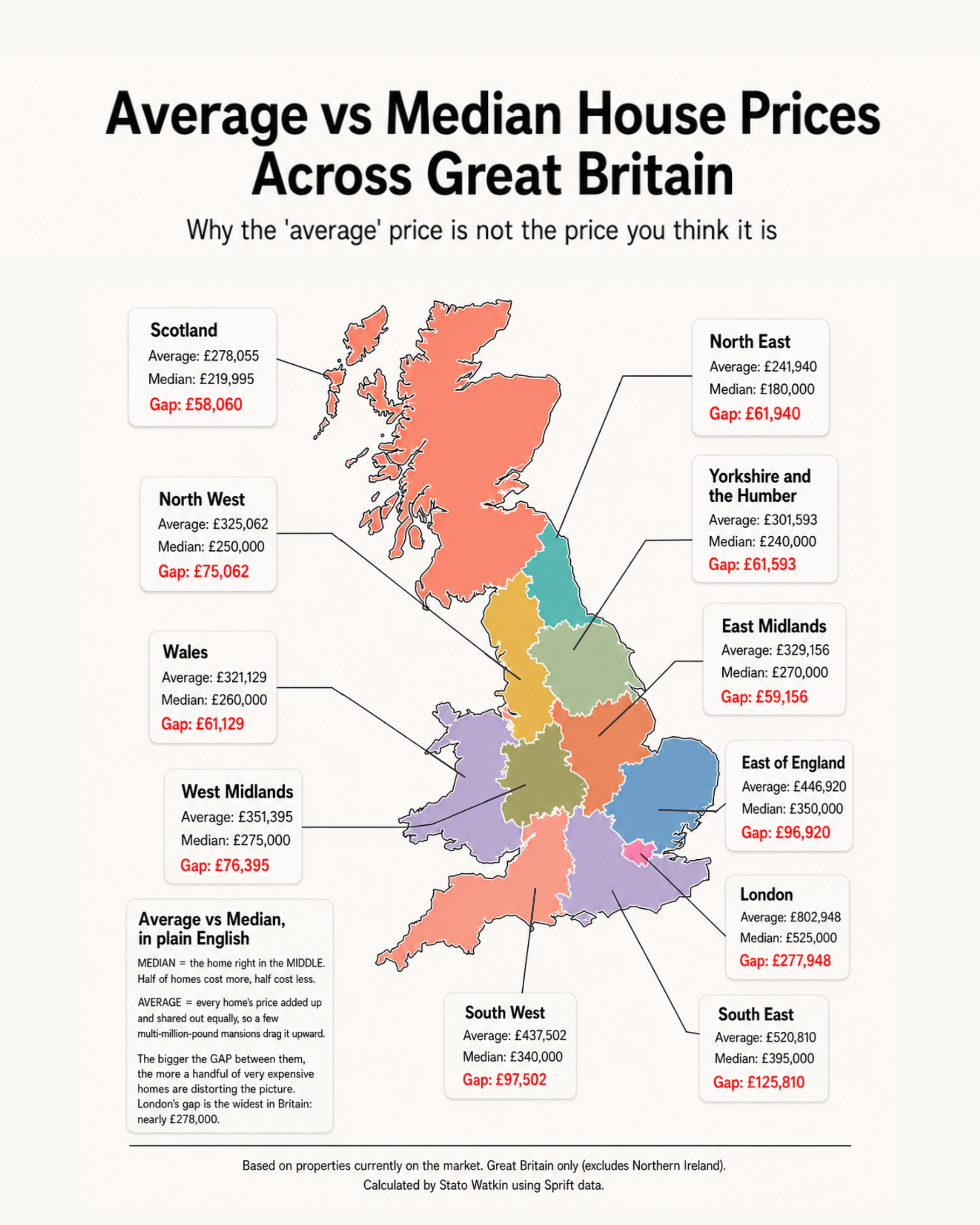
Take London. The average asking price right now is a dizzying £802,948. But the median, the price of the home sitting bang in the middle, where half cost more and half cost less, is £525,000. That is a gap of nearly £278,000. So which number is real? The median. The average is being hauled skyward by a small number of multi-million-pound mansions that most buyers will never look at, let alone buy.
Think of it like a room of ten people earning £30,000 each. A billionaire walks in. Suddenly, the "average" wage is millions, but nobody in that room is any richer. That is exactly what luxury homes do to the average house price.
You might ask why we have posted this.
In the final week of August and the first week of September, the average asking price of properties coming onto the UK market will rise by approximately £80,000. Why? The South West London property market is particularly quiet during July and August, even allowing for the usual school holiday slowdown. Then, across those two weeks, around 5,000 South West London homeowners put their properties on the market.
Because property values in these areas are so high, those new listings have a significant effect on the UK-wide average. When a typical three-bedroom terraced house sells for between £800,000 and £1 million, it does not take many new listings to pull the national average sharply upwards.
So next time you see an "average" price, ask what is hiding behind it.
Here is a question that catches almost everyone out: what does the "average" house price actually tell you? The honest answer is, often, not much.
Take London. The average asking price right now is a dizzying £802,948. But the median, the price of the home sitting bang in the middle, where half cost more and half cost less, is £525,000. That is a gap of nearly £278,000. So which number is real? The median. The average is being hauled skyward by a small number of multi-million-pound mansions that most buyers will never look at, let alone buy.
Think of it like a room of ten people earning £30,000 each. A billionaire walks in. Suddenly, the "average" wage is millions, but nobody in that room is any richer. That is exactly what luxury homes do to the average house price.
You might ask why we have posted this.
In the final week of August and the first week of September, the average asking price of properties coming onto the UK market will rise by approximately £80,000. Why? The South West London property market is particularly quiet during July and August, even allowing for the usual school holiday slowdown. Then, across those two weeks, around 5,000 South West London homeowners put their properties on the market.
Because property values in these areas are so high, those new listings have a significant effect on the UK-wide average. When a typical three-bedroom terraced house sells for between £800,000 and £1 million, it does not take many new listings to pull the national average sharply upwards.
So next time you see an "average" price, ask what is hiding behind it.